From the archive: AI commentary I wrote in late 2024 and early 2025
Amazon’s Bold Move into AI Chip Development

In a world where the ability to harness artificial intelligence defines competitive advantage, Amazon’s decision to develop its own AI chips is a declaration of intent. It signals a shift not only in technology but also in the balance of power among giants who have long dominated this space. As someone deeply engaged in engineering systems that rely on similar breakthroughs, I see this as both a technical and strategic milestone. To understand its implications, we must delve into the technology itself, its relevance today, and its potential to reshape the technological and social landscapes.
Why AI Chips Matter More Than Ever
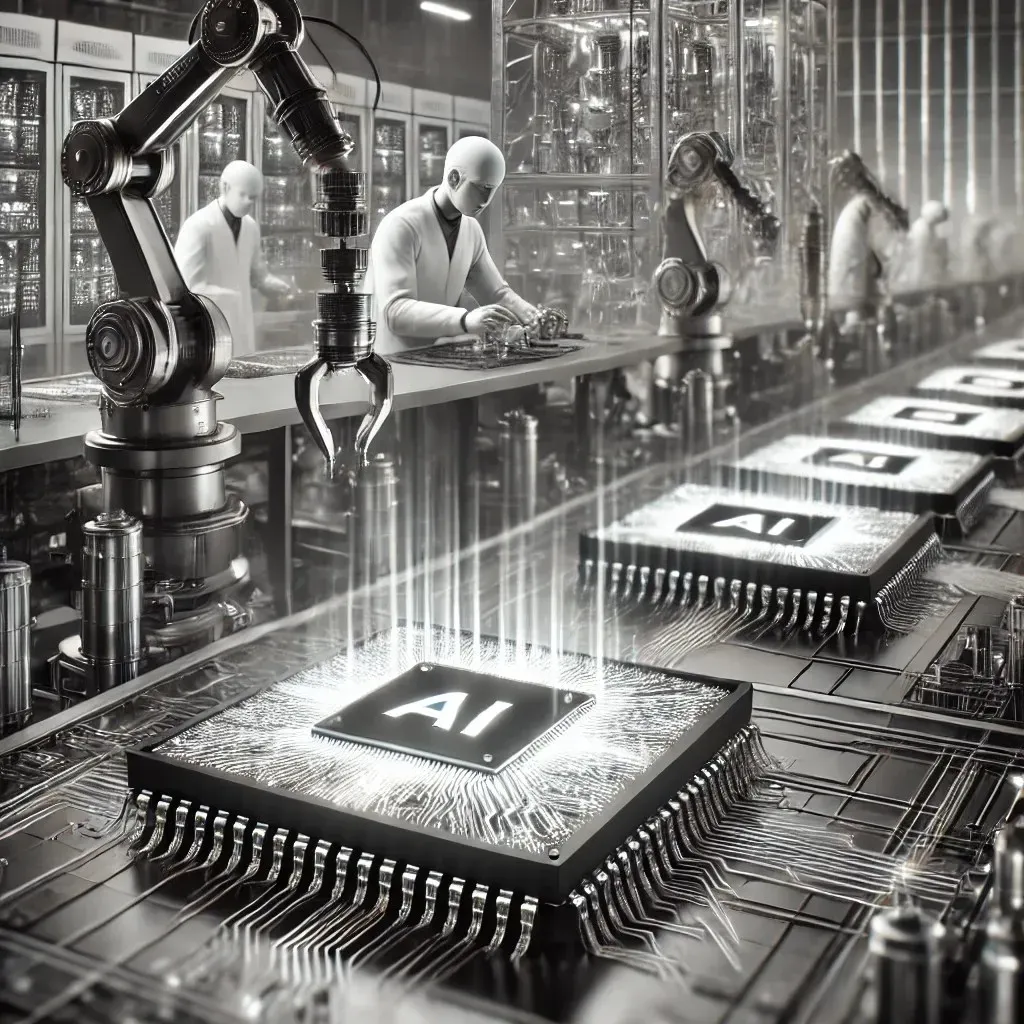
At its core, an AI chip is a specialized piece of hardware engineered to accelerate tasks central to artificial intelligence, such as training models and running inference. These chips are not just faster; they are optimized to handle the high-dimensional data and complex algorithms that drive machine learning. Traditional GPUs, the bread and butter of companies like Nvidia, have been critical in scaling AI, offering computational power tailored to deep learning. But there’s a cost: dependency.
Amazon’s pivot to developing its own chips, Trainium for training and Inferentia for inference, is a direct response to the constraints of this dependency. Building its own silicon allows Amazon Web Services (AWS) to create hardware uniquely suited to its operational needs, addressing bottlenecks in performance and cost. This is no mere cost-saving initiative; it is a play to gain deeper control over the infrastructure that underpins its cloud empire.
The Domino Effect of Building Custom Silicon
Developing custom chips isn’t just about technology. It reshapes ecosystems. AWS, which powers significant portions of the internet, will have a competitive edge, offering businesses chips designed for their exact workloads. This could disrupt Nvidia’s market dominance, pushing other cloud providers like Google and Microsoft to double down on their own innovations in hardware.
The social implications of this shift are equally profound. By reducing costs and increasing performance, Amazon makes AI more accessible to smaller players who previously found the costs prohibitive. Imagine a world where mid-sized startups can access the computational power required for breakthroughs in medicine or logistics without breaking their budgets. That democratization of AI is transformative, fostering innovation in spaces that were once monopolized by tech behemoths.
A Look Beneath the Surface of Amazon’s Plan
Trainium and Inferentia are not mere substitutes for Nvidia’s GPUs. They are purpose-built, each addressing critical stages in the AI workflow. Trainium optimizes the training phase, where massive datasets refine algorithms, while Inferentia targets inference, the process of deploying trained models for real-world applications. As someone who has developed predictive systems leveraging similar architectures, I see the power in this segmentation. It offers a balance between general-purpose performance and application-specific optimization.

This is not just an engineering challenge; it’s a cultural shift within Amazon. Building chips demands collaboration across hardware, software, and product teams. It’s a high-stakes endeavor requiring expertise in areas where Amazon has limited historical experience, from semiconductor fabrication to circuit design. Yet, the same company that built AWS into a $100 billion juggernaut has proven it can master complexity.
Where Does This Lead?
The first-order effects of Amazon’s chip initiative are clear: improved performance, lower costs, and reduced reliance on Nvidia. The second-order effects ripple further. Competitors will be forced to innovate faster, spurred by Amazon’s entry into the field. Nvidia, for instance, may need to accelerate its advancements in hardware or diversify its offerings to stay ahead. Smaller players in the semiconductor industry could find themselves courted by companies scrambling to replicate Amazon’s model.
The third-order effects could redefine how we think about cloud computing and AI. Today, the dominant narrative is that of a handful of companies controlling the flow of innovation. But as chip designs become more specialized, we might see the rise of niche providers offering solutions tailored to specific industries—healthcare, automotive, and beyond. This fragmentation could decentralize the AI ecosystem, fostering resilience and creativity.
A Future Shaped by Purpose-Built Hardware
The trajectory of AI depends on the marriage of software and hardware. Advances in algorithms are constrained without matching breakthroughs in silicon. This interdependence has broader implications than we often acknowledge. Imagine a future where AI systems predict climate patterns, optimize supply chains, and even generate art—not limited by the speed of their computations but propelled by them.
Amazon’s Trainium and Inferentia are early steps in this direction. But as quantum computing and other exotic architectures emerge, today’s chips could become stepping stones rather than endpoints. As I’ve experienced in building scalable systems, the challenge isn’t just about solving today’s problems; it’s about anticipating tomorrow’s needs.
The Social Contract of AI Development

Finally, we must consider the societal responsibilities that come with such advancements. Who benefits from faster, cheaper AI? How do we ensure that these tools are used ethically and inclusively? The democratization of AI is a noble goal, but it must be accompanied by frameworks that prevent misuse, whether by bad actors or unchecked systems. As someone passionate about fostering diverse and inclusive technology teams, I believe this is as critical as the engineering itself.
Amazon’s decision to enter the AI chip space is bold, strategic, and fraught with risk. But it is also a reflection of where we are headed—a world where the boundaries between hardware, software, and humanity blur. This isn’t just a technical evolution; it’s a reimagining of what is possible when we take control of the tools that shape our future.